
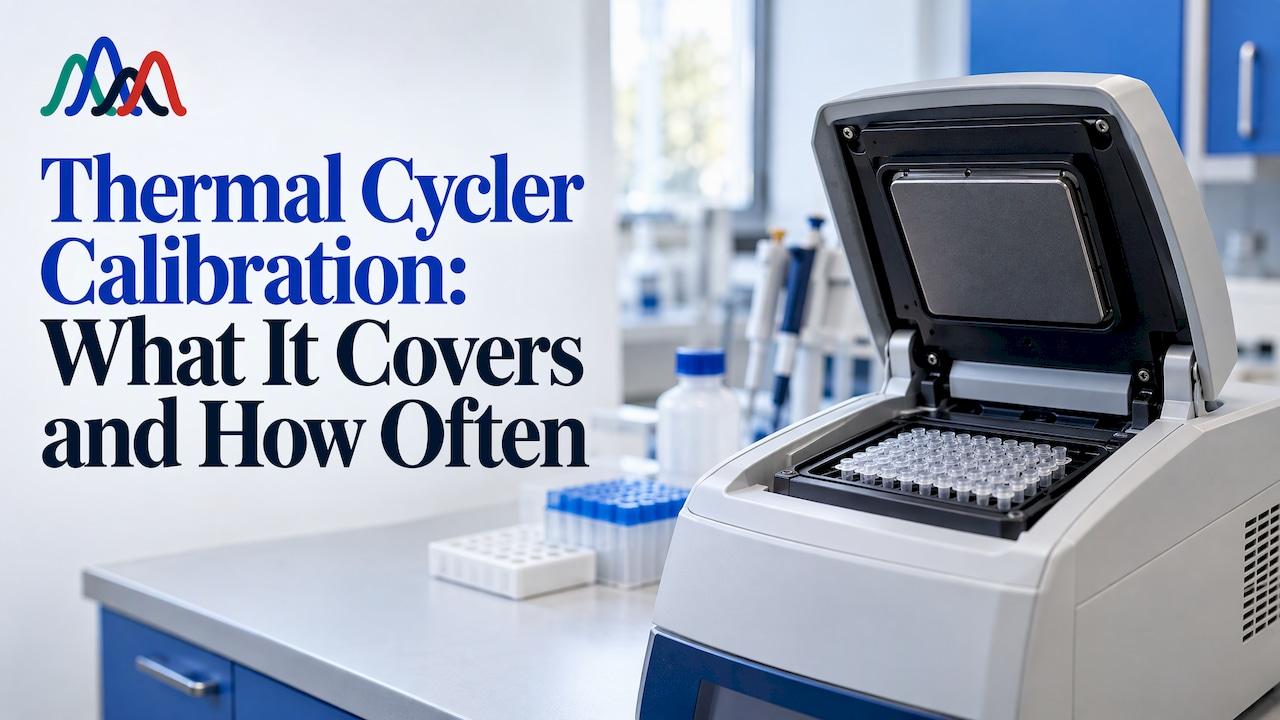
Thermal cycler calibration proves that the temperature your block displays is the temperature your samples actually reach, and that every well reaches it. It is done with an independent reference, on a schedule, and it is documented. If your lab runs PCR for sequencing, forensic, clinical or food-testing work, the calibration record is part of what makes a result defensible. For instruments such as the Veriti and 9700, our team handles PCR and qPCR instrument calibration and service and provides a written report for service work, so the record you need for an audit comes with the job.
TL;DR
- Calibration compares block temperature against an independent reference at set points, across representative wells, and checks ramp behavior. It never relies on the cycler's own sensor.
- Frequency is set by your regulator, accreditation body and the manufacturer. In the US, CLIA requires calibration verification at least every 6 months for regulated labs, and many guides call for an annual temperature check as a baseline.
- Re-check after a repair, a block or sensor replacement, or when well-to-well variation shows up in your data.
- An out-of-tolerance result means taking the unit out of service, recalibrating or repairing it, and documenting the outcome.
- A useful calibration service ends with a written report you can file against the instrument's record.
Table of Contents
- What thermal cycler calibration actually measures
- How a thermal cycler is calibrated
- How often to calibrate
- What to do when a unit is out of tolerance
- What a calibration service should deliver
- Planning calibration so it costs less and interrupts less
- Thermal cycling is only half the workflow
- Calibration for your lab
- FAQ
- Sources
What thermal cycler calibration actually measures
A thermal cycler heats and cools a metal block, and the reaction tubes sit in wells in that block. The display shows a set point, such as 95 °C for denaturation. Calibration asks whether the sample wells really reach that temperature and hold it.
The ANZPAA working group's 2025 recommendations for forensic laboratories name three parameters: temperature accuracy, temperature uniformity and ramping rates. They note that these influence the efficiency and specificity of PCR and ultimately the DNA profiles generated. That is the practical reason to care. A block that runs 1 °C cool at the annealing step, or a corner well that lags the center, shows up as weak peaks, allele dropout or inconsistent yields. Those symptoms are easy to blame on reagents or the capillary electrophoresis instrument, so calibration also saves troubleshooting time downstream.
Calibration, verification and validation are different things
Labs use these words loosely, so it helps to separate them:
- Calibration adjusts or characterizes the instrument against a reference so its readings agree with true temperature.
- Verification checks that the instrument is still within its specification, without necessarily adjusting it.
- Validation shows that the instrument, with your chemistry and protocol, gives the results you need.
The ANZPAA guidance puts the order clearly: calibration should confirm that accuracy, uniformity and ramping are consistent before validation studies begin on a new unit. Additional units then need verification, including a sensitivity series and a heating-block temperature check.
How a thermal cycler is calibrated
The method is the same in principle whatever the brand: put a trusted temperature measurement device in the block, run set points, and compare.
The National Institute of Justice's DNA amplification training module on thermal cyclers describes routine calibration as two tests. The first is a temperature calibration verification test, which checks sample block temperature against the manufacturer's factory specification using a temperature verification system kit. The second is a temperature non-uniformity test, which finds wells with unacceptable variation using the same kind of kit. Performance diagnostics such as cycle and rate tests are run alongside them.
Reference probes and well positions
The reference must be independent. A guide to accreditation for microbiological laboratories built on ISO 17025 states that labs should verify temperature, ramp rate, overshoot and undershoot, and hold time for thermal cyclers. In practice that means a calibrated probe or multi-sensor device traceable to a national standard, placed in representative wells, typically the four corners and the center at a minimum, with readings compared to the programmed set points. If the only evidence is the cycler's onboard sensor, you are asking the instrument to grade itself.
What the standards say
For food-chain microbiology, ISO 20836:2021 specifies requirements for installation, maintenance, temperature calibration and temperature performance testing of standard and real-time thermal cyclers for PCR-based detection of microorganisms. It also applies to other uses, so labs outside food testing often borrow its approach. Your own accreditation body and the instrument manual decide which tolerances apply to you.
A worked example
An older block-type cycler has a manufacturer procedure that checks block average at 95 °C. The temperature verification system user guide for the 9600 model says that if the block average at 95 °C differs from 95 °C by more than 0.75 °C, the system must be recalibrated. Say the average reads 94.1 °C. The difference is 0.9 °C, which exceeds that limit. The unit comes out of service, gets recalibrated and is re-verified before it runs another sample. Other models and checks carry their own limits, so always take the figure from the procedure for your exact instrument.

How often to calibrate
There is no single global number. The interval depends on who regulates you and how hard the instrument works.
| Source | What it asks for |
|---|---|
| US CLIA regulation, 42 CFR § 493.1255 | Calibration done and documented per the manufacturer's instructions, at least as often as the manufacturer recommends. Calibration verification at least every 6 months, and after complete reagent changes, major preventive maintenance, replacement of critical parts or unusual control trends. |
| SANAS TG 42-03 forensic DNA guide (South Africa, 2020) | Bi-annual diagnostic test runs, annual temperature calibration and uniformity tests, and annual calibration of the verification unit traceable to a national standard. |
| Temperature verification system user guide (2003) | Calibration verification test at least once a year. Non-uniformity test whenever well-to-well variation is suspected. |
| ISO 17025-based microbiology guidance | Intervals shorter than the time the equipment has been found to take to drift out of limits, based on documented experience. |
The CLIA rule applies to US clinical testing. Research and forensic labs follow their own funders, accreditors and quality manuals, so treat the table as a map of common practice and confirm your obligation with your quality manager.
What should shorten your interval
The SANAS and ISO 17025 guidance point to the same factors: the manufacturer's recommendation, the extent and severity of use, the environment, the uncertainty your work requires, and the drift history of the unit. A cycler that runs several shifts a day in a warm room drifts on a different schedule from one used twice a week. Keep the results of every check. Two or three years of records let you justify a longer or shorter interval with your own data, which is what auditors want to see.
Events that trigger an extra check
- A repair, or replacement of the block, Peltier elements or a sensor.
- Relocation of the instrument.
- Unexplained well-position patterns, such as edge wells failing more often than center wells.
- Control trends that move without a reagent explanation.
These match the CLIA triggers of major maintenance, replaced critical parts and unusual control trends.
What to do when a unit is out of tolerance
An out-of-tolerance result is a finding, not a disaster, if you handle it in order.
- Stop using the unit and label it so no one runs samples on it.
- Record the result with the instrument ID, date, set points, readings and the reference device used.
- Recalibrate or repair. The SANAS guide says that if the annual temperature calibration or uniformity test fails, the lab should contact licensed service support personnel. The verification system guide likewise requires recalibration when the limit is exceeded.
- Re-verify after the work, with the same test that failed.
- Review earlier runs. Look at what was amplified since the last passing check and decide, under your quality system, whether any results need review.
The repair step is where many labs lose time, because the unit is idle while a decision is made. Our team services block-type cyclers and real-time PCR instruments, including Veriti and 9700 thermal cyclers, and we support instruments that are no longer covered by the manufacturer. Reaching one group for both the calibration and the repair keeps the failed unit's history in a single report.
What a calibration service should deliver
Whether you calibrate in house or bring in a service provider, judge the job by its output. A calibration record that will stand up in an audit should identify the instrument (model, serial number, location), the reference device and the date of its own calibration, the set points tested, the wells measured, the readings against the targets, the pass or fail criteria and the outcome. It should also state what was adjusted or replaced.
That last point matters when you keep several cyclers. A written report per instrument lets you compare drift between units and between years. At ELIS, service work comes with a written report, and the answers to your technical questions come from instrument-service staff, not a general help desk.

Planning calibration so it costs less and interrupts less
Your regulator sets the minimum frequency, but your own planning sets the downtime and the cost. A few habits help in any lab:
- Calibrate on a calendar, not on failure. Putting every cycler on the same annual cycle, staggered by a few weeks, means one unit is out at a time and the rest carry the load.
- Bundle related work. If the genetic analyzer is due for maintenance, schedule both visits or remote tasks together. Our 3500 maintenance checklist lays out the daily to yearly routine for the capillary side, so the whole sequencing line follows one calendar.
- Keep trend data. Each reading you store shortens the next discussion about interval and helps you spot a unit that is slowly drifting.
- Know your triggers. A defined list of events that require an extra check prevents both skipped checks and unnecessary ones.
- Keep one point of contact. Calibration, repair and consumables for a connected workflow are easier to schedule when a single supplier knows the instruments in your lab.
Prices vary with instrument type, the number of units and whether work is done on site, so request a quote with your models and quantities listed.
Thermal cycling is only half the workflow
If your PCR products go to capillary electrophoresis, a drifting cycler and a worn array can produce the same symptoms: low signal, uneven peak heights, noisy baselines. Calibrating the cycler removes one variable. For the other side, we supply capillary arrays, POP polymers and buffers and reagents for Applied Biosystems analyzers, matched to your instrument by OEM part numbers. The 3500 troubleshooting guide helps you tell which side a problem sits on.
Calibration for your lab
We specialize in Applied Biosystems systems, from the thermal cycler to the genetic analyzer. For PCR and real-time PCR instruments, we offer calibration and service, and we support units that are out of manufacturer coverage.

Send us the models, serial numbers and the date of your last verification through the PCR and qPCR service page, and we will come back with the right plan for your fleet. For the sequencing side of the lab, see our genetic analyzer service.
FAQ
How is thermal cycler calibration different from a performance check?
Calibration compares block temperature to an independent, traceable reference and corrects or characterizes any difference. A performance check, such as the cycle and rate diagnostics the manufacturer provides, tests whether the instrument runs its programs correctly. Quality systems usually want both, with calibration traceable to a national standard.
Can I rely on the cycler's built-in self-test?
A self-test is a useful routine diagnostic, but proper calibration uses an independent reference probe or multi-well device in representative wells and compares it with the programmed set points. That independence is what makes the record meaningful to an auditor.
How often should I calibrate?
Follow the strictest of your regulator, accreditor and the manufacturer. US clinical labs under CLIA must perform calibration verification at least every 6 months, and several forensic guides call for annual temperature calibration plus more frequent diagnostics. Add an extra check after repairs or when well-to-well variation appears.
What happens if my thermal cycler fails calibration?
Take it out of service, record the result, and have it recalibrated or repaired by qualified service staff. Re-run the failed test afterward, and review samples processed since the last passing check under your quality procedures.
Sources
- ANZPAA Biology Validation Working Group: requirements of validation parameters for thermal cyclers (2025)
- National Institute of Justice: DNA amplification, thermal cyclers
- Accreditation for Microbiological Laboratories (ISO 17025 guidance)
- ISO 20836:2021, Microbiology of the food chain: thermal cyclers for PCR
- Thermal Cycler Temperature Verification System User Guide
- 42 CFR § 493.1255, calibration and calibration verification
- SANAS TG 42-03 Forensic DNA